Beacon Press just put out this short clip about Until it Hurts. Thanks to Jessie Bennett, Digital Content Developer and Blog Editor at Beacon.
Showing posts with label Until It Hurts. Show all posts
Showing posts with label Until It Hurts. Show all posts
Tuesday, August 16, 2011


Monday, August 15, 2011
PGA Championship winner had a real childhood

Keegan Bradley, the new PGA Championship winner, set himself apart in so many ways last week. He won one of golf's four major championships in his first season on the PGA Tour. He won with an improbable back nine that included a triple bogey (to drop him five shots off the lead with three holes to play) followed by back-to-back birdies. Even more remarkably, he won the first major championship he ever played in.
There's one more biographical footnote that separates Bradley from other tour pros. He had a childhood.
More accurately, he had a normal childhood. Bradley grew up in Vermont, the son of a teaching golf pro. His aunt, Pat Bradley, was one of the most successful players on the Ladies Professional Golf Association tour in the 1970s and 1980s. The adults in Keegan's life had the good sense to allow golf to be a part of his life, not his whole life.
Increasingly, that's an unusual way for kids with sports talent to grow up, as Bill Pennington explained this morning in the New York Times.
Although he is the son of a club teaching pro and the nephew of the L.P.G.A. Hall of Famer Pat Bradley, he did not specialize in golf as a youngster. He did not enroll in a hundred golf camps or travel away from home, boarding in a golf academy. He did not follow the path that is now so common to precocious athletes in most sports across America, which is to say he spurned suggestions he should quit all other sports and play golf year-round.
Bradley grew up in central Vermont. He was a ski racer in the winter and a golfer in the summer.
“People ask me all the time how I could be a pro golfer from Vermont, and they assume I must have went south a lot,” Bradley said Saturday. “But the truth is that when it started to snow, I put my clubs in the basement and didn’t touch them.”
In Until It Hurts, I write about kids who become early specialists. By eight or nine years old, they are full-time soccer goalies or tennis players. A small percentage of these children become fabulous players. They become varsity college athletes, attending school on full athletic scholarship. A few even become professional stars playing in big stadiums and earning millions of dollars a year.
Sadly, most do not. They advance as far as their talent will take them, usually high school sports -and no farther. Or the steady diet of one sport - spring, summer, fall and winter - eventually wears them down before they even get that far. As I write in Until It Hurts, they become victims of overuse injuries, ruptured ligaments, growth-plate injuries and the like. Or the sport ceases to be fun. Or what they want to do. So they quit before ever reaching their potential.
Keegan Bradley's parents played it right. They allowed their son to have a childhood, to explore many interests and eventually to excel at one. Keegan is the hero this week. Mr. and Mrs. Bradley deserve their own slice of the spotlight.
Friday, May 28, 2010
New York Times weighs in on overuse injuries

Jane Brody wrote about overuse injuries in youth sports in Tuesday's "Personal Health" column in the New York Times. The headline: For Children in Sports, a Breaking Point. I was glad to see it for a couple of reasons.
First, it brought attention to an issue that doesn't get very much - or as much as it deserves. Despite forums like this one and the efforts of many sports medicine experts, overuse injuries (totally avoidable if a few basics rules are observed) remain an under-reported issue. Among parents and coaches (my observation), there just isn't a sense of urgency about the problem.
Second, Brody cited Until It Hurts. In the column, she devotes several paragraphs to my brain-lock moment as a youth baseball coach (when I paid scant attention to my son's complaints of a sore shoulder). On that score, she refers to my "misguided behavior" and "foolish shortsightedness." She got it right both times.
The column reached a lot of readers. Wednesday morning, it ranked among the ten most e mailed articles in the newspaper.
I like Brody's long view of the problem:
"Clearly we’ve gone too far when the emphasis on athletic participation and performance becomes all-consuming and causes injuries that can sometimes compromise a child’s future."
Thursday, February 04, 2010
Sports scholarships and other false promises

Outstanding article in Sunday's Houston Chronicle on the false promise of college scholarships. The Chronicle's Jenny Dial does two interesting things.
First, she computes the percentage of high school athletes who are playing in college AND receiving money. She reports that in men's and women's basketball, men's and women's track and field, men's golf and men's soccer, it's less than one percent.
Second, she speaks with parents in the Houston area about what they spend on their kids' sports educations.
She writes: "A survey of several parents of boys and girls golfers in the area shows that on average, they spent nearly $11,000 a year on the sport. Basketball parents spent an average of $4,900 over six years, and parents of junior and senior soccer boys and girls spent an average of $8,000 for two years."
There's nothing wrong with that, unless parents are counting on a scholarship to balance the ledgers. Many aren't. Some are.
This is from Until It Hurts. I was spoke with UConn men's soccer coach Ray Reid:
"UConn has room to add only six to seven high school players each recruiting cycle, some years just four or five. Reid’s sense is that teenagers often have an easier time accepting the bad news than their moms and dads, for whom a child’s sports career has involved long years of driving carpool, pacing sidelines and writing checks. They’ve done their part. In so many words, they’re taking the position that it’s time to collect on the investment.
"Reid bristles as he recalls many conversations with parents that have followed this tortured path. It goes this way, he says. “Coach Reid, we invested a lot of money in my son’s career - $30,000 in ten years. We’d like a soccer scholarship to get some of it back.
“It angers me. I’m appalled by the attitude. My reaction is: “That’s interesting. Your son is a mutual fund!”
Thursday, October 15, 2009
Until It Hurts on Weplay.com

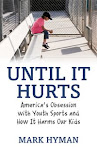
Over the next few weeks, Weplay.com will be running adapted excerpts from Until It Hurts. First up, a short piece on what kids observe - and what they'd like to change - about the adults who show up to coach their teams and root them on.
Friday, August 14, 2009
An enlightened approach to kids sports in Wisc.
Earlier in the week, I was a guest on Wisconsin Public Radio, an hour speaking about Until It Hurts and other kids' sports issues in the news, notably research showing a 150 per cent jump in injuries to kids during gym class.
During the show, host Joy Cardin and I spoke about how one objective for parents should be instilling a lifelong love of sports, not (or not just) training kids to be picked for an 11-12 travel team.
A listener replied with this email.
"My high school recognized this youth athletics problem in the early 90's. They started offering a class called "Life Sports". A class that opened the doors to other sporting activities that people enjoy throughout their life. For instance: Canoeing, Golf, Tennis, Racquetball, Trap Shooting, Downhill Skiing, and Horseback Riding. Sports that adults can participate in, long after the Dreams of being a Professional Football, Basketball, Volleyball, Soccer, and Baseball player have ended."
Another emailed with a tip about a gym teacher in the local high school, Pam Haffely. Haffely also was rethinking old ideas about gym, adding yoga, treadmills and visits to the weight room to old standards like softball and floor hockey.
It makes sense to broaden gym this way, as a strategy for keeping kids participating when their high school days are over. Sensible, but unusual. Are there gym offerings like this where you live?
Monday, July 13, 2009
Gender equity in the game, but not yet on sidelines
Difficult to argue with the transformational power of Title IX on girls' participation in organized sports. As noted in Until It Hurts (page 45, if you're reading along): "The year Title IX took effect, 1972, boys playing high school sports outnumbered girls by twelve to one. Twenty years later, the edge had shrunk to fewer than three boys for every girl. The latest statistics from the National Federation of State High School Associations show girls comprising about 40 per cent of high school athletes."
All the more puzzling then that female coaches have achieved such modest gains and, in some cases, actually lost ground. Nicole LaVoi, associate director of the Tucker Center for Research on Girls and Women in Sports, has been tracking this stat. So have other sport researchers including pioneers in the field, Vivian Acosta and Linda Carpenter. Last month, I visted Nicole at the Tucker Center's home base, the University of Minnesota, to hear more.
Before we go trumpeting across-the-board equality for women in organized sports, consider this:
At the college level, just 21 per cent of all men's and women's teams are coached by females. Less than half of WOMEN'S teams - 41 per cent - are coached by females. Prior to the enactment of Title IX in 1972, more than 90 per cent of head coaches in women's sports were females, according to data from Acosta and Carpenter.
LaVoi and Mike Messner, the noted kids sports researcher and professor of gender studies at the University of Southern California, each has extended the coaching analysis to rec sports. They've found women under represented there too.
LaVoi's survey of the Minnesota Youth Soccer Association showed 15 per cent of head coaches were women - 24 per cent for girls teams, five per cent for boys. Messner studied a Southern California youth sports community, reporting that just 13 per cent of head coaches in the American Youth Soccer organization there were women. I highly recommend Mike's recent book on these issues: It's All for the Kids: Gender, Families and Youth Sports.
What this means for girls'/women's participation overall in youth sports is unknown but not too difficult to surmise. Seems to me the situation is self-perpetuating. Fewer female role models on the sidelines means fewer girls aspiring to one day become coaches.
Monday, June 29, 2009
Youth sports and the guests who refuse to leave
In Until It Hurts, I refer to a "hostile takeover" of sports for kids by adult minders who invited themselves to the party long ago and, like annoying dinner guests, are the last to realize it's time to leave. How long ago did the problems begin? I write about it in this piece for the Pennsylvania Gazette, the alumni magazine of the University of Pennsylvania.
Tuesday, June 23, 2009
So three days later, he was out there pitching
One of the most thoughtful articles about Until It Hurts so far - by Bob Blubaugh of the Carroll County Times. Thanks Bob.
Monday, June 08, 2009
One evening on the Until It Hurts publicity tour
My friend Stan Charles invited me on to "Inside Press Box" to chat about the book.
Inside PressBox May 17, 2009: Youth Sports from PressBox on Vimeo.
Wednesday, May 20, 2009
Sports injuries and kids in the Wall Street Journal
"The Juggle," the Wall Street Journal's family and work balance blog, posted yesterday on injuries in youth sports. Sue Shellenbarger writes about her daughter's ACL injury - suffered during a high-school basketball game - and reconstructive surgery. There's a brief mention of Until It Hurts and Ben's injury and operation.
At last count, there were 24 comments posted, including these:
"I have seen an unbelievable amount of serious injury among young ballet dancers. I believe this is related to three key issues: The intensity of ballet training, the very early specialization of most dancers, and the heartbreaking incidence of poor nutrition and eating disorders."
"My daughter is in 3rd grade and is playing spring soccer. It amazes me at this age how many of the other teams are playing soccer year-round (they play indoor soccer in the winter). While it certainly gives them an advantage now against the other 3rd grade teams that don’t play year-round, I wonder if those girls are going to be more likely to burn-out and/or end up with injuries."
"My little brother was just told that he will have to sit out this soccer season for knee surgery. He has been playing sports (started with hockey then basketball and soccer) for the last six years and because of the continual year round use of his muscles they have just given out."
"I know a 12 yo swimmer who may have to have shoulder surgery - thus ending her swimming career. Of course, the child in question has been swimming seriously competitively since at least 8. She’s not the only one I know of. And the pressure IS great - there is a kid I know who played HS varsity football as a freshman - got tackled and lost a kidney! And he’s thinking about going back next year!"
Reminds me of a story from my book: A sports medicine doc is speaking with a high school football player and his parents in his office. The young man was tackled hard during a game and suffered a serious injury to his spleen. The doctor notes that another blow to the spleen could have horrible consequences and recommends that the player quit the sport. The parents do not accept this advice. They begin to negotiate - in front of their child. What if their son wore a little padding around his middle? No? How about A LOT of padding?
A sport psychology consultant who works with the physician told me about the case. She was stunned by the parents' reaction. “They didn’t want to hear that he could not play football again. That was the most extreme case of denial we’ve encountered in 15 years.”
Monday, May 18, 2009
"All Things Considered" considers Until It Hurts
My son Ben joined me for an interview that aired yesterday on National Public Radio's "All Things Considered." I had been hoping for a chance for the two of us to speak about Until It Hurts and generally about the highs and occasional lows of his life as a kid athlete. This was our first chance and worth the wait.
Ben did a superb job, explaining that many kids are competitive, want more for their efforts than a participation trophy and love the games as much as their parents do. At the end of the interview, he makes a crucial point: this discussion isn't about abandoning sports for kids, but improving them.
Ben did a superb job, explaining that many kids are competitive, want more for their efforts than a participation trophy and love the games as much as their parents do. At the end of the interview, he makes a crucial point: this discussion isn't about abandoning sports for kids, but improving them.
Monday, May 11, 2009
Macy Causey is going 60 miles per hour
Dateline NBC did a piece last night on the life and times of Macy Causey, the 8-year-old girl who drives race cars and rapidly is becoming her own youth sports national brand. She has a racing team, a web site and a Macy fan club. Like few second graders, she has touched off an amazing run of national media coverage, starting with a profile in the New York Times. Later, a live interview on the Today Show and then Dateline.
Did I mention she's 8?
I got a call from a Dateline producer and am interviewed in the story raising a point that is central to Until It Hurts: Are we allowing kids to be kids?
Did I mention she's 8?
I got a call from a Dateline producer and am interviewed in the story raising a point that is central to Until It Hurts: Are we allowing kids to be kids?
Visit msnbc.com for Breaking News, World News, and News about the Economy
Thursday, May 07, 2009
When a youth sports athlete calls it quits
It would be interesting (read: frightening) to tote up the money that is spent each year putting kids in a position to become college athletes: club and elite team fees, travel, hotels, private tutors, college sports placement services, showcases, athlete dvds. Have I forgotten anything?
Some kids are happy they made the effort, of course. But for others intercollegiate sports isn't all it's cracked up to be. They quickly learn that at the college level, especially Division I, college sports is a job. A full-time one, at that.
In Until It Hurts, I write about one such athlete, Fran Murray, who spent his high school years focused on a goal to make the leap to Division I baseball. It turned out to be the goal of the coaches and adults around him, though. As he explains, a few weeks into fall practice, he was wondering what he was doing on the baseball field and how to escape. “Every day, it felt more and more stupid. I kept asking myself: What am I doing wearing these pants and jacket? I should be doing my homework. I should be doing something beneficial to me down the road. I felt like a child out there. That’s when the tipping point came.”
Murray quit the team and hasn't looked back.
This piece in the Newark Star Ledger by columnist Mark Diionno reminded me of Fran Murray's story. It's a father's perspective on the end of a daughter's school sports life and a lesson on how to gracefully accept that moment.
Saturday, April 25, 2009
Next stop: LL Day at the Oakland Coliseum
I'm heading to Oakland for the A's "Little League Day." Before Sunday's game, I'll be on a panel with team trainer Steve Sayles and pitcher Dallas Braden speaking about youth baseball injuries.
Linking here to several articles about Until It Hurts that have appeared in Bay Area newspapers in the last few days. Lowell Cohn in the Santa Rosa Press-Democrat and Carl Steward writing for the Bay Area News Group - San Jose Mercury News, Oakland Tribune, among other papers. I'm collecting news clips, podcasts of interviews at untilithurts.com. Check it out.
Linking here to several articles about Until It Hurts that have appeared in Bay Area newspapers in the last few days. Lowell Cohn in the Santa Rosa Press-Democrat and Carl Steward writing for the Bay Area News Group - San Jose Mercury News, Oakland Tribune, among other papers. I'm collecting news clips, podcasts of interviews at untilithurts.com. Check it out.
Friday, April 10, 2009
Why did you pitch your son while he was hurt?
I'm posting a QandA about Until It Hurts and some of the thinking that went into the book. The article appears at Sportsletter.org.
David Davis, who conducted the interview, posed some interesting questions from 'What do you think is the lesson of Tiger Woods' story?" to "In the book, you write about being your son's baseball coach and having him pitch in a game when he had tendonitis. Why did you have him pitch while he was hurt?" (Well, because it was playoff time?).
It's a very good overview of the book.
Tuesday, April 07, 2009
Until It Hurts excerpt at SI.com
The response to the book has been very gratifying. Good reviews, for the most part. And some amazing email from adults contacting me with their personal stories and concerns.
Good news today: An excerpt from the book is now posted at SI.com. The excerpt chosen deals with youth sports injuries (the kind that occur because kids are starting too young, specializing in a sport too soon, training too intensely). I hope you'll check it out.
Good news today: An excerpt from the book is now posted at SI.com. The excerpt chosen deals with youth sports injuries (the kind that occur because kids are starting too young, specializing in a sport too soon, training too intensely). I hope you'll check it out.
Wednesday, March 18, 2009
Until It Hurts, the website
Until It Hurts, the website just went live. Please visit. I welcome your comments.
The url: untilithurts.com.
The url: untilithurts.com.
Monday, February 23, 2009
Drug testing and the lesson of Taylor Hooton
Texas just released results from the second year of its drug testing program for high school athletes. Of 19,000 tests administered, the number of positive results was just seven.
This just fuels the debate about such tests. Advocates say they're an effective deterrent - kids don't do performance-enhancing drugs when they fear being caught. Skeptics question how a program that catches seven kids a year could be worth the cost - $6 million.
Texas, New Jersey and Illinois are the only states that test high school athletes for steroids. Florida dropped its program recently, after testing 600 kids and turning up one steroid user.
I get into this subject in depth in Until It Hurts, my book about the troubled state of youth sports (Publication date: April 1). I write at length about Taylor Hooton, the Texas teenager and baseball pitcher who committed suicide. His dad believes Taylor took his life because of earlier steroid abuse.
In the book, Don Hooton tells me that his son got instructions from a coach to "get bigger" if he hoped to make the varsity the following season. Taylor opted to get bigger using steroids, tragically.
I like what Don Hooton has to say to the Associated Press about the value of mandatory steroid testing, even when the program turns up just a few positives: "They don't stop testing Olympic athletes just because most of them don't test positive."
My view is this: the alternatives to testing programs that cost too much and catch few drug abusers are even less acceptable.
Wednesday, December 31, 2008
Looking back on the year in youth sports -and ahead
As the hours tick down on 2008, I wanted to thank those of you following the blog for your suggestions, interest, input. Thanks also to print and cyber media that have been generous in citing various posts or linking to the blog. These outlets include: BusinessWeek.com, ESPN.com, sportsbusinessjournal.com, Goodhousekeeping.com, Awfulannouncing.com, Beaconbroadside.com, Baltimoresun.com, Courier-journal.com, Dallaschild.com, Trackmom.com, sportsmediasociety.blogspot.com, womenshoopsblog.blogspot.com, title-ix.blogspot.com.
A large thank you goes to my sons Ben, 20, and Eli, 18, for their support. Ben for encouraging me to step up posts to the blog, which went from one every six months to three (and sometimes five a week) in July. Eli for his fantastic technical assistance. If it's on the blog and required even a modicum of technical know-how, chances are Eli is responsible.
2009 should be interesting, with the release of my book in April, a book publicity tour and various writing and reporting assignments on youth sports issues. I hope you'll continue reading and contributing.
Here's a good way to close the year - with Doug Abrams's look back at encouraging youth sports stories from 2008.
Happy New Year, everyone.
Subscribe to:
Posts (Atom)




 Posts

