We try to keep this a (mostly) commercial-free zone. Today is an exception. The New York Times is offering a series of on-line sessions on the topic of sports, kids and injuries. The class meets weekly starting in late February and the instructors are first-rate, Times reporters Gretchen Reynolds and Alan Schwarz.
The cost is $135. I hear it's an easy A.
Showing posts with label Alan Schwarz. Show all posts
Showing posts with label Alan Schwarz. Show all posts
Friday, February 04, 2011


Tuesday, December 28, 2010
On youth football and protecting kids' heads
Last Sunday, The New York Times ran another great piece on head trauma in youth football. This time the subject was prevention. Alan Schwarz visited an unusual coach, Bobby Hosea, who teaches kids to tackle properly and safely -not leading with their heads.
Hosea is quoted in the piece: “When a kid gets paralyzed or dies, it’s not an accident — the injuries happen because people never teach kids how to tackle the right way. Everyone’s talking about head injury awareness, awareness, awareness. What are you going to do about it? It drives me absolutely crazy. It’s time for this to stop!”
I've been in head-trauma mode these past few days, reading about cause and effect. I picked up a terrific book, Head Games by Chris Nowinski. It's the story of Nowinski, a former Harvard football player and pro wrestler, unraveling the mystery of his own brain injuries. And in the process, triggering a national conversation.
I spoke recently with Dr. Robert Cantu, the neurosurgeon who diagnosed Nowinski and is now leading the debate about chronic traumatic encephalopathy (CTE), an Alzheimer’s-like brain disease associated with repetitive head trauma. Cantu and Nowinski established the Sports Legacy Institute in Boston. Its mission is to raise awareness. It's succeeding.
Watch this. If you're a parent of a youth athlete, watch twice.
Monday, December 20, 2010
Youth sports poll: Concussions don't worry kids
The latest ESPN the Magazine includes an interesting survey. The Mag polled 600 people (300 players, 100 coaches, 100 parents, 100 athletic trainers) in 23 state about concussions. I like the questions, simple and neutral. Not much to like about the attitudes of players, though. A majority seems not to take concussions that seriously. Have a look at the question below. (Click on it for easier reading). More than half say they'd rather win a big game with a teammate suffering a concussion than lose without him.
The quick and easy way to interpret these findings is that the attitudes of players are the largest problem. Maybe. I'd say it's more complicated. Kids are sponges. They listen not only to what we say but what we do. They are influenced by education campaigns that warn of dangers from concussions. They also understand that as a society we value tough guys.
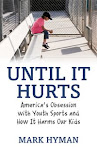
This is from Until It Hurts:
"Are adults sending messages, subtly or otherwise, that winning comes first and guarding the health of high school players second? Do youth players fear that they have to choose between listening to their bodies and satisfying their coaches and parents?
"In his New York Times piece, [Alan] Schwarz addresses these questions with powerful reporting. A physician at a Connecticut high school recalls sending a player from an opposing team to the sidelines with a concussion. The coach instructed the player to switch his uniform number and surreptitiously return to the game. A team doctor in Charlottesville, Virginia laments the recklessness of parents who will not listen to any advice that takes their child out of a game. “I have had parents tear up the form that I’ve filled out strongly recommending their child not play, and shop a doc to get their kid OK’d,” he says.

Friday, November 12, 2010
Kids' concussions and Lou Gehrig's Disease
I meant to comment on this a few months back - but didn't. Lou Gehrig lives on as a sports icon in part because of his legendary tolerance for pain; he refused to leave games despite injuries that would have sidelined others for weeks.
Now researchers are asking whether Gehrig's refusal to acknowledge injury - and not Lou Gehrig's Disease - might have contributed to his death.
Youth football coaches, take note.
Now researchers are asking whether Gehrig's refusal to acknowledge injury - and not Lou Gehrig's Disease - might have contributed to his death.
Youth football coaches, take note.
Monday, September 13, 2010
Concussions up for basketball players - but why?

A just-released study points to a a major rise in the number of kids suffering serious head injuries while playing basketball.
According to the study published today in the Journal Pediatrics, kid players 5 to 19 treated in hospital emergency departments for basketball-related traumatic brain injuries rose 70 per cent from 1997 to 2007.
Assuming this is right, why would that be? I got a call from a reporter Friday (the study was embargoed until today) wanting to discuss that and hear any theories I might have.
My first thought - shared by many, probably - is that heightened awareness about concussions is a large factor. There's been so much publicity about the unseen harms of concussions, not just lately but going back to the mid 2000s. I highly recommend this piece from 2007 written by Alan Schwarz of the New York Times. It's remarkable in showing how little attention coaches, parents and players were paying to head injuries.
A second theory. Were substantially more kids playing basketball in 2007 than in 1997? I haven't been able to answer that, not directly. As close as I've been able to come is to establish that there were many more kids playing high school sports at the end of that 10-year span than the start. Total participation for all high school sports grew from 6.3 million in 1997-98 to 7.4 million in 2007-2008.
Here are things I believe are NOT responsible: Kids are getting bigger and faster (not that much bigger and faster); referees are allowing more physical play (zero evidence supporting that); sportsmanship is in steep decline so more elbows are flying (even more far-fetched).
This isn't the first study to point out how ignorant we all were about head injuries in youth sports. Doubtful it will be the last
Tuesday, February 16, 2010
USC's 13-year-old QB; Congrats to Alan Schwarz
Reading about David Sills last week, I wondered what people who actually study kids would make of the situation. Not football tutors. Not college football coaches. Child advocates, health professionals.
I expected all would be riled up about USC's offer of a football scholarship to Sills, a seventh grader. But that wasn't quite right. Here's my piece from ParentDish.
Unrelated but important: Today Alan Schwarz of the New York Times won the Polk Award for sports reporting. He's responsible for hundreds of important stories about concussions in athletes, from the pros to youth leagues. He has changed attitudes and saved a lot of kids. Congratulations Alan. And thanks.
Friday, October 30, 2009
NFL concussions and the "trickle-down effect"

Two great articles this week on concussions in youth sports. Alan Schwarz in today's New York Times continues his remarkable coverage of the issue.
This quotation from Alan's piece gets to the heart of the issue. (The issue being, until the NFL takes seriously, or seriously enough, the consequences of head trauma, neither will the millions of youth leagues).
“Walking off the pain in an N.F.L. game turns into walking it off in a Little League game — the trickle-down effects on high school and college players are very real and can be fatal,” Representative Hank Johnson, Democrat of Georgia, said in the hearing.
Over at The Daily Beast, Buzz Bissinger takes on pretty much the same subject, though he argues more broadly against the macho sports culture which reaches down to high schools and, in some communities, even youth sports. There's also a nice mention in Buzz's story of Until It Hurts, specifically to reporting in the book about avoidable injuries.
Those of you who've read it know a 16-year-old pitcher in my family had one.
Monday, March 16, 2009
To curb head injuries, a new law in Washington
In a move that will be applauded by parents groups - and should be copied by other states - Washington's senate last week passed a bill that requires young athletes with head injuries to get a medical assessment before being allowed back into games. The Washington state house had already passed such a bill.
Concussions among young players - how they are sometimes ignored by players and dismissed as inconsequential by coaches - have been getting much attention nationally. In Washington, the issue gained prominence in 2006 when a junior high school student, Zack Lystedt, suffered two head injuries one after another during a football workout. Zack suffered brain damage from the blows and still has trouble walking.
Troubling questions in cases such as Zack's are: Did the adults in charge recognize the signs of a concussion? Send a clear message to kids that blows to the head are serious business? Insist that they speak up at the first sign of a concession - dizziness, blurred vision and so on?
The best story I've read on the subject is one of the first, by Alan Schwarz of the New York Times. Alan has written about this issue at many levels of sports, from the National Football League to sports for kids. In this piece, he recounts incidents in which coaches clearly did not see the greater danger. In one case, after a football player suffers a suspected concussion and is ordered out of the game by a doctor, a high school coach instructs the player to change jersey numbers so he can re-enter the game secretly. A fine piece of reporting, and a disturbing story.
Thank you Doug Abrams.
Subscribe to:
Posts (Atom)




 Posts

