I'm back at my laptop after spending the weekend attending the Lake Placid Sport Forum, a first-time conference to consider the troubled state of youth sports.
About two dozens of us were invited - a college hockey coach, three former U.S. Olympians, two orthopedic surgeons, a physical therapist, a sport psychologist, a radio talk-show host, two former NHL players and last, and perhaps least, six journalists, among others. For a couple of days, we sat around a large round table listening to each other's ideas about where sports for kids went off the tracks and coming up with a plan to do something about it.
Whether we've set the stage for a serious, ongoing effort remains to be seen. I felt privileged to be included.
A word about the organizers. Mara Smith, Lake Placid resident, sports performance consultant, had the idea to bring together a group to talk about a rescue plan for kids and sports. Mike Richter, part-time Lake Placid resident, Yale grad, father of youth hockey players, former New York Rangers goalie, got behind the idea and helped make it happen. Mark Messier, Richter's former Rangers teammate, attended and, like Richter, spoke eloquently throughout the sessions. The Aspen Institute provided support and a terrific moderator in Charlie Firestone.
The issues - how do you persuade parents that travel teams at age 8 actually can prevent kids from reaching their potential as athletes? - are complicated, bordering on intractable. I'm encouraged that 25 people are concerned enough to have spent a weekend talking about it.
Tuesday, September 29, 2009


Monday, September 21, 2009
Sportsmanship at an all-time low - or maybe not

It's Professor YouthSportsParents. This fall, I'm teaching a graduate seminar on youth sports and society at McDaniel College outside Baltimore. Tonight's topic: parents, coaches and sportsmanship.
We'll speak with Washington Post reporter Annie Gowen, who wrote this interesting piece about a group of Maryland soccer moms and dads banished from the sidelines for conduct unbecoming a grownup in corduroy slacks - or some like infraction. What I found particularly fascinating was the league's take-no-prisoners attitude about the adults' behavior. In essence, do the crime, serve the time.
Students have been doing their own research, looking into local leagues and associations, speaking with officials, evaluating codes of conduct. They'll share what they've learned about differing approaches to the sportsmanship question.
One issue I'll be raising: Is sideline etiquette at youth sports games truly in decline? The pat - and perhaps even accurate - answer is, of course. This survey underscores the point. The Awards and Recognition Association asked people whether sportsmanship is worse now than when they were growing up. Sixty-three percent said yes. Among folks 60 and older, 81 per cent thought sportsmanship had suffered since their kid sports playing days.
Still, that's hardly conclusive. Could it be that we simply hear more about rude, overbearing sports parents than we did in years past, thanks to CNN, ESPN and niche blogs like this one? That while our behavior at youth sports games can be rude, even loutish, we were just as rude and loutish in the old days? I don't know. And, more important, I doubt anyone truly does.
Friday, September 11, 2009
On my reading list, LeBron's "Shooting Stars"
It's a stretch to recommend a book that you haven't read, but what the heck. I'm giving a nod to Shooting Stars, the new LeBron James memoir. I like that the book's focus is James's formative years in Akron, Ohio, and bonds forged with teammates on and off the court. That interests me a lot more than the more predictable superstar pap about life in the fishbowl of the NBA.
Full disclosure: James' co-author Buzz Bissinger, was a college classmate and a fellow editor of mine at the Daily Pennsylvanian back in, uh, well, during the Pleistocene Period. Buzz, author of the classic Friday Night Lights, also generously blurbed my book. He may be two feet shorter than James but this is a rare case in which the athlete and his collaborator are of equal stature.
Full disclosure: James' co-author Buzz Bissinger, was a college classmate and a fellow editor of mine at the Daily Pennsylvanian back in, uh, well, during the Pleistocene Period. Buzz, author of the classic Friday Night Lights, also generously blurbed my book. He may be two feet shorter than James but this is a rare case in which the athlete and his collaborator are of equal stature.
Tuesday, September 08, 2009
Friday, September 04, 2009
What all youth baseball coaches should know

Today's assignment. Read this.
It's the American Sports Medicine Institute's new "position statement" on youth baseball pitchers and injury prevention.
In July, ASMI's top researcher, Glenn Fleisig, shared findings from a study of youth pitchers for an article I wrote for the New York Times.
The study looked at 29 youth pitchers from ages 9 to 14. All were given instructions to throw their curves — fastballs and changeups, too — as if they were in a real game. The results were surprising, even to the researchers. Curves were less stressful than fastballs and nothing linked curves to elbow injuries. The real culprit for these injuries - along with inadequate conditioning and pitching mechanics, according to ASMI - seemed to be overuse, kids throwing too many pitches and playing baseball too many months of the year.
Fleisig got clobbered for the study's observations about curveballs. One ESPN talking head, after a discourse on how he blew up his elbow throwing curves in high school, called Fleisig a "quack." Other reaction was nearly as over-the-top.
These revised guidelines, which Dr. Fleisig tells me were prompted by the "buzz" over the Times story, do not retreat from Fleisig's earlier comment about curves. "Throwing curveballs has been suggested as a risk factor, but the existing research does not support this," the report states.
The ASMI statement does flesh out important dos and don'ts for keeping kid pitchers safe. Note that USA Baseball's recommended pitch limits are more restrictive than Little League Baseball's. That's a subject for another day.
Wednesday, September 02, 2009
Why sports for kids are good for our social lives

As part of my research for Until It Hurts, I spent a blustery December morning in Boston locating the office of Lyle Micheli. My hands were numb and my ears about frozen when I arrived but it was worth it to see Micheli, one of the nation's top docs for injured youth athletes.
Micheli has been treating such patients for decades. In 1974, he and several associates started the first sports injury clinic for kids in the U.S. at Children's Hospital. He's still there. And on a hectic day, he might see dozens of patients.
Micheli also has a reputation for straight talk, especially about the problems percolating in youth sports. That was true the day I visited.
I asked Micheli why parents are emotionally invested in the sports lives of children. He explained that there is a lot at stake for the adults, more than many admit or appreciate themselves.
And it's not all about winning and losing, he said.
"In a mobile society, if your child is on a travel team, you suddenly have 30 new people who are your best friends," Micheli told me. "You’re going to barbecues with the soccer team and so on. Participation on the team gives the family social entrees, social prerogatives, it would not have."
Micheli spoke of parents so emotionally involved in their kids' sports lives that they'd seemingly forgotten why they signed up their sons and daughters in the first place.
"I had a physician's family come in," Micheli said. "The mother was an emergency-room doctor. Her son had Little League elbow, which I operated on. The first question out of her mouth in the recovery room was, 'When do you think he can play again?' Not, 'How did the surgery go?' Or, 'How's the elbow going to be?' The loss of perspective was amazing."
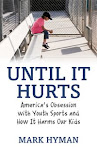
I was intrigued with the idea that kids' sports can hold such power over adults and made it a major part of my book.
Then this month, sport researchers at Purdue University published a study in the Journal of Sport and Exercise Psychology that examines how youth sports changes the lives of adults. It was exploring the same issue, yet from a side that seemed kinder, gentler.
Here's some of what the Purdue researchers reported:
-Spouses with kids in youth sports became better communicators (with one another) and better organized. This was attributed to the coordination needed to make it on time to practices, games, private lessons and the rest.
-Some parents explained that watching their children excel in sports motivated them to pick up a sport themselves. One said that when her child took up tennis, she followed.
-Friendships among parents often outlasted the careers of their kid players. Even so, moms and dads said that they went through an emotional letdown when their kids' playing days ended and the adults lost their "play dates."
In a Purdue press release, one of the researchers, Alan Smith explained: "I don't think it's terribly surprising that parents connect with one another, but what was surprising is the intensity of that connection. Many view themselves differently, as well as their children differently, after exposure to youth sports."
That intensity can be channeled in constructive ways. (See Purdue study).
Or not. (Consult Dr. Micheli).
Subscribe to:
Posts (Atom)




 Posts
Posts

