Nice weekend in the Bay Area, the highlight of which was serving on a "youth sports sanity" panel with A's pitcher Dallas Braden and trainer Steve Sayles at the Oakland Coliseum. The audience was about 500 youth league coaches, parents and kids.
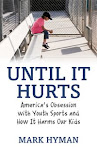
I made a few remarks about Until It Hurts, explaining how the project got started and how not long into it, my son Ben's elbow injury cast things in a different light. Steve and Dallas then spoke about the importance of playing different sports, keeping expectations for our kids reasonable, and the chances of your kid ending up in a big league uniform (in a word, remote).
The QandA session was interesting.
Sayles got several questions about weight training for kids. A former college baseball player, he pointed out that there isn't much upside to a kid lifting weights before puberty. So put the bar bells away until 14 or 15, earliest.
As expected, Braden was the crowd favorite and got most of the attention. What team was his favorite growing up in nearby Stockton? (The Giants). What are his memories of the 1989 Earthquake World Series? (The TV tuned to the series, a lamp shaking violently behind the tube, and his mother accusing him of playing a practical joke). Does he ice after his pitching starts? (No. Stretches, though).
A nice mom wearing a baseball cap asked me a question. She wanted to know if I ever got hate mail. (Not as often as you'd think).
Tuesday, April 28, 2009


Saturday, April 25, 2009
Next stop: LL Day at the Oakland Coliseum
I'm heading to Oakland for the A's "Little League Day." Before Sunday's game, I'll be on a panel with team trainer Steve Sayles and pitcher Dallas Braden speaking about youth baseball injuries.
Linking here to several articles about Until It Hurts that have appeared in Bay Area newspapers in the last few days. Lowell Cohn in the Santa Rosa Press-Democrat and Carl Steward writing for the Bay Area News Group - San Jose Mercury News, Oakland Tribune, among other papers. I'm collecting news clips, podcasts of interviews at untilithurts.com. Check it out.
Linking here to several articles about Until It Hurts that have appeared in Bay Area newspapers in the last few days. Lowell Cohn in the Santa Rosa Press-Democrat and Carl Steward writing for the Bay Area News Group - San Jose Mercury News, Oakland Tribune, among other papers. I'm collecting news clips, podcasts of interviews at untilithurts.com. Check it out.
Tuesday, April 21, 2009
Soccer parents make headlines for wrong reasons
What could be worse than being banished from a kids' soccer game for ref baiting? Here's something: Being banished from a kids' soccer game for ref baiting, then having your suspect behavior chronicled in the Washington Post.
This happened today to parents of the Legacy travel team in Bethesda, Maryland.
Post reporter Annie Gowen has the interesting story of a bunch of parents punished for berating an official during a heated game at the end of last season. To its credit, the Washington Area Girls Soccer League took aggressive action, calling the behavior "nothing less than egregious" and banning the adults from the sidelines for two games. A referee stood sentry to make certain that the parents complied.
Gowen writes: "The soccer league, home to many of the area's best soccer players with 600 teams and more than 15,000 participants, has a strict disciplinary system, in which players and coaches receive yellow or red cards for rough or unsportsmanlike conduct. Some have to explain themselves at disciplinary hearings. There are also sportsmanship liaisons on each team, who are supposed to keep fellow parents in check.
"Kathie Diapoulis, league president, said the parents had gone too far. The league's disciplinary board has had better luck barring individual parents from attending games in the past three years rather than fining them, because the parents would pay the money and continue the bad behavior.
"We have taken a strong stance," Diapoulis said. "It's important. This isn't the World Cup. . . . And for the parents to be shrieking on the sidelines and belittling people goes against everything we're trying to do. . . . It's not acceptable behavior."
Gowen doesn't speak with the Legacy players, 13-year-olds, for their views - under the best of circumstances kids that age are mortified by their parents. But she spoke with several of the moms and dads who, in an encouraging note, seemed genuinely sorry about the incident and the fallout.
She quotes one anonymous parent saying, "It's embarrassing. This is seventh-grade soccer."
Another, who hadn't attended the game in which the bad behavior occurred, told the Post: "We accepted our punishment, and we're abiding by it. One of the functions of sports is to teach sportsmanship. When we as parents violate that, the girls need to see there are consequences to those actions."
A multi-generational teaching moment, you might say.
This happened today to parents of the Legacy travel team in Bethesda, Maryland.
Post reporter Annie Gowen has the interesting story of a bunch of parents punished for berating an official during a heated game at the end of last season. To its credit, the Washington Area Girls Soccer League took aggressive action, calling the behavior "nothing less than egregious" and banning the adults from the sidelines for two games. A referee stood sentry to make certain that the parents complied.
Gowen writes: "The soccer league, home to many of the area's best soccer players with 600 teams and more than 15,000 participants, has a strict disciplinary system, in which players and coaches receive yellow or red cards for rough or unsportsmanlike conduct. Some have to explain themselves at disciplinary hearings. There are also sportsmanship liaisons on each team, who are supposed to keep fellow parents in check.
"Kathie Diapoulis, league president, said the parents had gone too far. The league's disciplinary board has had better luck barring individual parents from attending games in the past three years rather than fining them, because the parents would pay the money and continue the bad behavior.
"We have taken a strong stance," Diapoulis said. "It's important. This isn't the World Cup. . . . And for the parents to be shrieking on the sidelines and belittling people goes against everything we're trying to do. . . . It's not acceptable behavior."
Gowen doesn't speak with the Legacy players, 13-year-olds, for their views - under the best of circumstances kids that age are mortified by their parents. But she spoke with several of the moms and dads who, in an encouraging note, seemed genuinely sorry about the incident and the fallout.
She quotes one anonymous parent saying, "It's embarrassing. This is seventh-grade soccer."
Another, who hadn't attended the game in which the bad behavior occurred, told the Post: "We accepted our punishment, and we're abiding by it. One of the functions of sports is to teach sportsmanship. When we as parents violate that, the girls need to see there are consequences to those actions."
A multi-generational teaching moment, you might say.
Thursday, April 16, 2009
Today's word to remember: Sportsmanship
This isn't new and it really isn't about sports for kids, little ones anyway. I couldn't resist posting.
Tuesday, April 14, 2009
Real Sports seeks interviews with sports parents
HBO's Real Sports wants to speak with parents for an upcoming piece on youth sports. I'm passing on a note from the segment's producer, Amani Martin. (FYI: I do not work for HBO and am not involved in production of the story).
HBO’s Real Sports with Bryant Gumbel is developing a story on the current climate in youth sports in which parents are increasingly invested in the athletic pursuits of their children. We’re looking for parents of children (ideally ages 3 through 10) who have invested large amounts of time, money, and energy into their children’s sporting activities. Ideally, you’re a parent whose investment in youth sports is connected to a hope that focusing on your children’s sports will one day lead to a college scholarship or pro career. The point of the piece is to illuminate the evolution in the seriousness of youth sports; this is not meant to be a judgmental story on parents’ decision-making on how to raise their children. Please contact: Amani Martin, Producer, Real Sports with Bryant Gumbel. Direct line: (212) 512-1859. Collect calls will be accepted. Thank you very much.
HBO’s Real Sports with Bryant Gumbel is developing a story on the current climate in youth sports in which parents are increasingly invested in the athletic pursuits of their children. We’re looking for parents of children (ideally ages 3 through 10) who have invested large amounts of time, money, and energy into their children’s sporting activities. Ideally, you’re a parent whose investment in youth sports is connected to a hope that focusing on your children’s sports will one day lead to a college scholarship or pro career. The point of the piece is to illuminate the evolution in the seriousness of youth sports; this is not meant to be a judgmental story on parents’ decision-making on how to raise their children. Please contact: Amani Martin, Producer, Real Sports with Bryant Gumbel. Direct line: (212) 512-1859. Collect calls will be accepted. Thank you very much.
Monday, April 13, 2009
Sports training for babies may be overrated
Discouraging news for parents who have invested heavily in sports DVDs for toddlers and even infants. (I just bought one as a gift for a cousin whose new baby will be under heavy pressure to start at linebacker for Penn State in 2027).
These training tools probably accomplish nothing.
I admit I had my suspicions. Now they've been confirmed by the American Academy of Pediatrics, which recently published a study concluding that TV and videos for kids under 2 may not influence skill development.
From the AAP: "Researchers looked at the amount of time 872 children spent watching television or videos from birth to 2 years of age, then assessed their language and visual motor skills at age 3. When researchers adjusted for other factors that could influence these skills, such as maternal education and breastfeeding, the effect of television appeared neutral. Contrary to many parents’ perception that television viewing is beneficial to their children’s brain development, the researchers found no evidence of such a benefit."
Ok, next time I buy the infant tackling dummies.
These training tools probably accomplish nothing.
I admit I had my suspicions. Now they've been confirmed by the American Academy of Pediatrics, which recently published a study concluding that TV and videos for kids under 2 may not influence skill development.
From the AAP: "Researchers looked at the amount of time 872 children spent watching television or videos from birth to 2 years of age, then assessed their language and visual motor skills at age 3. When researchers adjusted for other factors that could influence these skills, such as maternal education and breastfeeding, the effect of television appeared neutral. Contrary to many parents’ perception that television viewing is beneficial to their children’s brain development, the researchers found no evidence of such a benefit."
Ok, next time I buy the infant tackling dummies.
Friday, April 10, 2009
Another warning about kids and curveballs
Little League Baseball continues to allow kids to throw curveballs. Before deciding the issue, it's waiting for results of a five-year study due to be completed in 2011.
Meanwhile, the medical evidence against kids throwing curves continues to pile up.
Researchers at Rush University Medical Center in Chicago recently released a study on children and pitching injuries. Their conclusions include this one: Youth pitchers should not learn curves until age 14, two years after Little League. “For pitchers under 14 years old, we encourage fast ball and change-up pitches and discourage the use of a curveball to prevent injury,” said Dr. Charles Bush-Joseph, sports medicine specialist at Rush and co-author of the report.
This is hardly a surprising conclusion. Or a new one. Many surgeons have been saying the same thing for years. Robert Kerlan, the surgeon who cared for Sandy Koufax, had this to say about kids and curves in 1976.
"The unnatural contortions of the arm and elbow are harmful enough to the pros, to say nothing of young athletes whose bones and joints are still growing. We shouldn't put pressure on them that will ruin the development of their skeletal structures and lead to deformities."
Local Little Leagues don't need to wait for Williamsport. They can ban curves on their own, and a few progressive ones have done so. Why haven't more? Enforcement of a no-curve policy is a legitimate issue. Umpires would have to be trained to recognize a curve right away and be prepared to warn - after multiple infractions, even eject - pitchers. That seems surmountable and, if it saves a kid's arm, worth the trouble. The bigger issue, it seems, is the attitude of the adults. Would we support, promote, defend this? Sign me up. I'm locking arms with the late Dr. Kerlan.
Thank you, Doug Abrams.
Meanwhile, the medical evidence against kids throwing curves continues to pile up.
Researchers at Rush University Medical Center in Chicago recently released a study on children and pitching injuries. Their conclusions include this one: Youth pitchers should not learn curves until age 14, two years after Little League. “For pitchers under 14 years old, we encourage fast ball and change-up pitches and discourage the use of a curveball to prevent injury,” said Dr. Charles Bush-Joseph, sports medicine specialist at Rush and co-author of the report.
This is hardly a surprising conclusion. Or a new one. Many surgeons have been saying the same thing for years. Robert Kerlan, the surgeon who cared for Sandy Koufax, had this to say about kids and curves in 1976.
"The unnatural contortions of the arm and elbow are harmful enough to the pros, to say nothing of young athletes whose bones and joints are still growing. We shouldn't put pressure on them that will ruin the development of their skeletal structures and lead to deformities."
Local Little Leagues don't need to wait for Williamsport. They can ban curves on their own, and a few progressive ones have done so. Why haven't more? Enforcement of a no-curve policy is a legitimate issue. Umpires would have to be trained to recognize a curve right away and be prepared to warn - after multiple infractions, even eject - pitchers. That seems surmountable and, if it saves a kid's arm, worth the trouble. The bigger issue, it seems, is the attitude of the adults. Would we support, promote, defend this? Sign me up. I'm locking arms with the late Dr. Kerlan.
Thank you, Doug Abrams.
Why did you pitch your son while he was hurt?
I'm posting a QandA about Until It Hurts and some of the thinking that went into the book. The article appears at Sportsletter.org.
David Davis, who conducted the interview, posed some interesting questions from 'What do you think is the lesson of Tiger Woods' story?" to "In the book, you write about being your son's baseball coach and having him pitch in a game when he had tendonitis. Why did you have him pitch while he was hurt?" (Well, because it was playoff time?).
It's a very good overview of the book.
David Davis, who conducted the interview, posed some interesting questions from 'What do you think is the lesson of Tiger Woods' story?" to "In the book, you write about being your son's baseball coach and having him pitch in a game when he had tendonitis. Why did you have him pitch while he was hurt?" (Well, because it was playoff time?).
It's a very good overview of the book.
Tuesday, April 07, 2009
Until It Hurts excerpt at SI.com
The response to the book has been very gratifying. Good reviews, for the most part. And some amazing email from adults contacting me with their personal stories and concerns.
Good news today: An excerpt from the book is now posted at SI.com. The excerpt chosen deals with youth sports injuries (the kind that occur because kids are starting too young, specializing in a sport too soon, training too intensely). I hope you'll check it out.
Good news today: An excerpt from the book is now posted at SI.com. The excerpt chosen deals with youth sports injuries (the kind that occur because kids are starting too young, specializing in a sport too soon, training too intensely). I hope you'll check it out.
Monday, April 06, 2009
More on Little League Baseball and pitch counts
Few people (as in none that I know of) follow the politics of Little League Baseball pitching rules as closely as Steve Kallas.
Over the years, Steve has been a persistent critic of LLB for failing to protect kids from too many pitches, curve balls and alike. He has kept an especially close eye on policies, in effect starting in 2007, regarding pitch counts.
The rules have been modified since, including changes in 2009. But Steve still sees room for improvement. In this recent blog post, he makes many good points but the best one is this: Why not let orthopedic surgeons and researchers decide the issue? In other words, the people who understand the physical limits of 12-year-old elbows and shoulders? To be fair, Little League has looked to such experts and has adjusted its rules based on their advice. But why not err on the side of safety?
The reporting for Until It Hurts underscored this for me. Surgeons are seeing overpitched kids in their offices every day. They understand the problem far better than the most well-intentioned coach, parent, private tutor and Little League administrator.
Over the years, Steve has been a persistent critic of LLB for failing to protect kids from too many pitches, curve balls and alike. He has kept an especially close eye on policies, in effect starting in 2007, regarding pitch counts.
The rules have been modified since, including changes in 2009. But Steve still sees room for improvement. In this recent blog post, he makes many good points but the best one is this: Why not let orthopedic surgeons and researchers decide the issue? In other words, the people who understand the physical limits of 12-year-old elbows and shoulders? To be fair, Little League has looked to such experts and has adjusted its rules based on their advice. But why not err on the side of safety?
The reporting for Until It Hurts underscored this for me. Surgeons are seeing overpitched kids in their offices every day. They understand the problem far better than the most well-intentioned coach, parent, private tutor and Little League administrator.
Subscribe to:
Posts (Atom)




 Posts
Posts

