Every year, it's more difficult to tell the difference between the Little League World Series and the REAL World Series. The latest example:
SOUTH WILLIAMSPORT - Little League Baseball will use instant replay at this year's World Series to review questionable home runs and other close plays at the outfield fence, beating the major leagues in instituting a system to review some disputed calls.
A Little League "game operations replay official" would need "clear and convincing" evidence to overturn an umpire's ruling on the field, according to the rule.
Replays would likely be rarely used, Keener said, and if used would likely cause a delay of 30 to 45 seconds. *
Thursday, July 31, 2008


Monday, July 28, 2008
Youth sports and George W. Bush
The latest from my e-mail box:
July 28, 2008
Dear Little League Friends and Supporters,
As you may know, Little League Tee Ball teams have been invited to the White House for games on the South Lawn for the past seven years. Two games have already been played this summer, with the final game to be played on Sunday, September 7.
The theme for this last game under the administration of President George W. Bush will honor the families of the men and women serving on active duty in the U.S. Military.
The deadline to enter is Monday, August 4, 2008.
Editor's note- Sorry for the short notice.
July 28, 2008
Dear Little League Friends and Supporters,
As you may know, Little League Tee Ball teams have been invited to the White House for games on the South Lawn for the past seven years. Two games have already been played this summer, with the final game to be played on Sunday, September 7.
The theme for this last game under the administration of President George W. Bush will honor the families of the men and women serving on active duty in the U.S. Military.
The deadline to enter is Monday, August 4, 2008.
Editor's note- Sorry for the short notice.
Friday, July 25, 2008
MMA
Mixed Martial Arts is an intense, violent and rapidly growing sport. It isn't just for adults anymore, either.
ESPN's Outside the Lines had a great piece this week on kids as young as 7 and 8 being trained as MMA fighters. This is well worth watching. Pay particular attention to the end of the report. Drake, 14, is asked what would happen if he told his dad he'd had enough of the sport and wanted to quit. His dad then is asked the same question.
ESPN's Outside the Lines had a great piece this week on kids as young as 7 and 8 being trained as MMA fighters. This is well worth watching. Pay particular attention to the end of the report. Drake, 14, is asked what would happen if he told his dad he'd had enough of the sport and wanted to quit. His dad then is asked the same question.
Thursday, July 24, 2008
MLB's good deed: The Breakthrough Series
A thumbs up to Major League Baseball for a smart youth sports event it's hosting this week.
The event is the Breakthrough Series, a three-day audition for high school juniors and seniors hoping to play baseball in college. The wrinkle is that that kids participating, for the most part, are from inner cities and disadvantaged backgrounds. They don't have the finances to pay their way to for-profit showcase tournaments.
The Breakthrough Series is being held at MLB's Urban Youth Academy in Compton, Calif. It's a fabulous complex, with diamonds, batting cages and, as impressive, study areas and a wonderful library filled with baseball books. I had the pleasure of visiting in 2006 and meeting the director, former big leaguer, Darrell Miller. I've been critical of MLB for so many blunders over the years. MLB deserves considerable praise for the Urban Youth Academy. It's a gem.
Anyway, the kids participating in the series are coming from all parts of the country. They'll be observed by dozens of college coaches. And their teachers for the week include Rod Carew and Frank Robinson. As one player told me when I shared that news: "Awesome."
I've written about the Breakthrough Series in next week's Sports Business Journal.
The event is the Breakthrough Series, a three-day audition for high school juniors and seniors hoping to play baseball in college. The wrinkle is that that kids participating, for the most part, are from inner cities and disadvantaged backgrounds. They don't have the finances to pay their way to for-profit showcase tournaments.
The Breakthrough Series is being held at MLB's Urban Youth Academy in Compton, Calif. It's a fabulous complex, with diamonds, batting cages and, as impressive, study areas and a wonderful library filled with baseball books. I had the pleasure of visiting in 2006 and meeting the director, former big leaguer, Darrell Miller. I've been critical of MLB for so many blunders over the years. MLB deserves considerable praise for the Urban Youth Academy. It's a gem.
Anyway, the kids participating in the series are coming from all parts of the country. They'll be observed by dozens of college coaches. And their teachers for the week include Rod Carew and Frank Robinson. As one player told me when I shared that news: "Awesome."
I've written about the Breakthrough Series in next week's Sports Business Journal.
Wednesday, July 23, 2008
Pursuing athletic scholarships
Good article in last Sunday's Dallas Morning News on athletic scholarships. The reporter, Brandon George, asks parents: If you had it to do again, would you go to the trouble and expense of training up your child for college sports?
Answer:
Yes. Parents felt their kids had benefitted from structure, education and "life experiences."
And definitely not...for the scholarship money. When it was there at all, those dollars turned out to be far less than the parents bargained for.
"It definitely wouldn't be worth it from a money perspective if you look at it that way," said Tom Geppert, whose son, Scott, was a senior forward for SMU's soccer team last season, told the Morning News. The full piece is here.
Bill Pennington had a similar piece in the New York Times last March.
Answer:
Yes. Parents felt their kids had benefitted from structure, education and "life experiences."
And definitely not...for the scholarship money. When it was there at all, those dollars turned out to be far less than the parents bargained for.
"It definitely wouldn't be worth it from a money perspective if you look at it that way," said Tom Geppert, whose son, Scott, was a senior forward for SMU's soccer team last season, told the Morning News. The full piece is here.
Bill Pennington had a similar piece in the New York Times last March.
Tuesday, July 22, 2008
Curveballs and Little Leaguers
I recently came across this quote about youth pitchers and curveballs.
"The unnatural contortions of the arm and elbow are harmful enough to the pros, to say nothing of young athletes whose bones and joints are still growing. We shouldn't put pressure on them that will ruin the development of their skeletal structures and lead to deformities."
Speaker: Robert Kerlan, Sandy Koufax's orthopedic surgeon.
Spoken: 1976.
Admittedly, I am fixated on this issue. But it is incredible to me that Little League Baseball - and other youth leagues - continue to resist rules banning curves. The notion that the clinical evidence isn't there is laughable. How much evidence did Little League need before requiring batting helmets?
"The unnatural contortions of the arm and elbow are harmful enough to the pros, to say nothing of young athletes whose bones and joints are still growing. We shouldn't put pressure on them that will ruin the development of their skeletal structures and lead to deformities."
Speaker: Robert Kerlan, Sandy Koufax's orthopedic surgeon.
Spoken: 1976.
Admittedly, I am fixated on this issue. But it is incredible to me that Little League Baseball - and other youth leagues - continue to resist rules banning curves. The notion that the clinical evidence isn't there is laughable. How much evidence did Little League need before requiring batting helmets?
Monday, July 21, 2008
Until It Hurts
Drumroll....
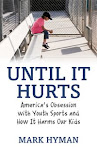
My youth sports book will be titled "Until It Hurts." Publication, by Beacon Press, is scheduled for April 2009. As Jon Miller used to tell fans when his memoir came out - in April -"Hey, it makes a great Christmas gift!"
So far this spring/summer, three books are out about youth sports: Game On by Tom Farrey of ESPN; Warrior Girls by Michael Sokolove, a contributor to the New York Times Sunday Mag (which ran an excerpt from the book back in May); and one just out, Six Good Innings, by former San Diego newspaperman and columnist Mark Kreidler. I've read Tom's and Mike's books and need to pick up Mark's.
My appetite for books on youth sports is greater than the average reader's. But I've found a lot of good reporting and commentary. I hope they sell well, almost as well as that title out next spring.
My youth sports book will be titled "Until It Hurts." Publication, by Beacon Press, is scheduled for April 2009. As Jon Miller used to tell fans when his memoir came out - in April -"Hey, it makes a great Christmas gift!"
So far this spring/summer, three books are out about youth sports: Game On by Tom Farrey of ESPN; Warrior Girls by Michael Sokolove, a contributor to the New York Times Sunday Mag (which ran an excerpt from the book back in May); and one just out, Six Good Innings, by former San Diego newspaperman and columnist Mark Kreidler. I've read Tom's and Mike's books and need to pick up Mark's.
My appetite for books on youth sports is greater than the average reader's. But I've found a lot of good reporting and commentary. I hope they sell well, almost as well as that title out next spring.
Wednesday, July 09, 2008
Organized sports and exercise
This one makes perfect sense, yet it surprised me.
The American College of Sports Medicine recently publicized a study comparing the amount of exercise kids get playing organized sports versus playing on their own (i.e., without direct adult supervision). Want to guess the results?
The kids playing on their own consistently got more physical activity. Reason: There were no timeouts, breaks between innings, substitutions, minutes on the bench, etc.
The study also compared organized and free play for enjoyment and "peer victimization," which I assume simply means the bigger, more athletic kids making life miserable for the ones just struggling to stay with the program. In these categories, the data showed kids enjoying themselves slightly more after organized sports (or "elimination games" as they're called in the study.) No one got picked on in either category, so no results to report on peer victimization.
Again, makes sense, though I wonder how long after these games the researchers spoke to their subjects. Also, whether an effort was made to speak to a representative group of children from both winning and losing teams. Right after games, kids tend to feel these things deeply both ways. A half-hour later, in my experience many kids can't remember who won or lost. As opposed to the coaches and parents.
I've spoken to many people about the pros and cons of free play and organized sports, but the exercise issue has never come up. Anyway, credit where it's due: The researchers are Karla Bruggeman and David Dzewaltowski. Their survey group consisted of 29 children in grades four through six.
The American College of Sports Medicine recently publicized a study comparing the amount of exercise kids get playing organized sports versus playing on their own (i.e., without direct adult supervision). Want to guess the results?
The kids playing on their own consistently got more physical activity. Reason: There were no timeouts, breaks between innings, substitutions, minutes on the bench, etc.
The study also compared organized and free play for enjoyment and "peer victimization," which I assume simply means the bigger, more athletic kids making life miserable for the ones just struggling to stay with the program. In these categories, the data showed kids enjoying themselves slightly more after organized sports (or "elimination games" as they're called in the study.) No one got picked on in either category, so no results to report on peer victimization.
Again, makes sense, though I wonder how long after these games the researchers spoke to their subjects. Also, whether an effort was made to speak to a representative group of children from both winning and losing teams. Right after games, kids tend to feel these things deeply both ways. A half-hour later, in my experience many kids can't remember who won or lost. As opposed to the coaches and parents.
I've spoken to many people about the pros and cons of free play and organized sports, but the exercise issue has never come up. Anyway, credit where it's due: The researchers are Karla Bruggeman and David Dzewaltowski. Their survey group consisted of 29 children in grades four through six.
Subscribe to:
Posts (Atom)




 Posts
Posts

